Showing posts with label Microgeneration Certification Scheme. Show all posts

Thursday, 5 December 2024

Moving Fast - Solar Uptake on New Homes


New data provided by the Microgeneration Certification Scheme (MCS) shows that the proportion of new homes built in England that come with solar PV has more than doubled in the last 12 months.

In the last quarter of 2023 it was estimated that 13% of new homes that completed construction had solar PV fitted by the developer.  This figure has risen to 29% in the most recent quarter and will continue to grow as housebuilders in England further transition to the 2021 version of Part L of the Building Regulations.

As the number of new homes with solar PV built by private developers has increased, the average installed power (kWp) per new build installation is falling.  

Prior to the new Building Regulations coming into force, solar on new homes was driven by either local planning requirements or fitted by self-builders as a personal preference.  Self-builders would size a system for a cost-effective contribution towards their own energy requirements.  Solar to meet a planning condition was on a site-wide basis and tended to be concentrated onto a few homes on the development to meet the condition in the most cost-effective way.  

By contrast the new Building Regulations apply individually to each plot but once the required energy performance of the building is met, developers generally see little reason to extend a PV system further - resulting in generally smaller PV installations.  The effect of this can be seen in the kWp/install column where the average has reduced over the period from 3.8kWp per installation to 2.8kWp.

Also worth noting is that solar on new buildings has risen from being 19% of MCS certified solar installations in England to 34% over the period.  As already mentioned, this transition has further to run and I predict that by the end of 2025, new build solar will account for at least 50% of MCS solar installations in the UK.


Notes on the Analysis

The number of new build MCS solar PV installations in the quarter was expressed as a proportion of new build housing completions in the same period to arrive at a percentage of new homes built with solar PV.

When registering a new solar PV installation with the MCS, the installer must tick a box to say whether the installation is on a new building.  The brilliant, publicly available MCS data dashboard does not currently allow users to filter the data on this basis, but the team at MCS responded to a request from Solar Energy UK and kindly provided us with the data.  I hope this functionality can be added in future.

The MCS certificate is issued only when the system is commissioned, which occurs after second fix.  This creates the potential for a timing difference between the MCS data and the data based on practical completion of the building (which may come a few weeks later).  The error this creates is mitigated against by aggregating to quarterly data.

It is also worth mentioning that it was not possible to split the MCS new build data into residential and commercial installations, so I have had to assume that the total is all residential, which will result in an over-estimate, but one that reduces as the number of new build homes with solar grows.  On the other hand not all solar installations will run through the MCS so this mitigates the over-estimate, as does focusing on the number of installations rather than the installed power (commercial solar tends to be larger systems in lower number).

Data for housebuilding completions is taken from this ONS dataset, which is quarterly, and only available up to Q2 2024.  The dataset was extended by one quarter by reference to this NHBC data which was used to scale the figure for Q2 to Q3.



Tuesday, 22 February 2022

How Progressive Building Regulations Made Scotland a Solar Powerhouse


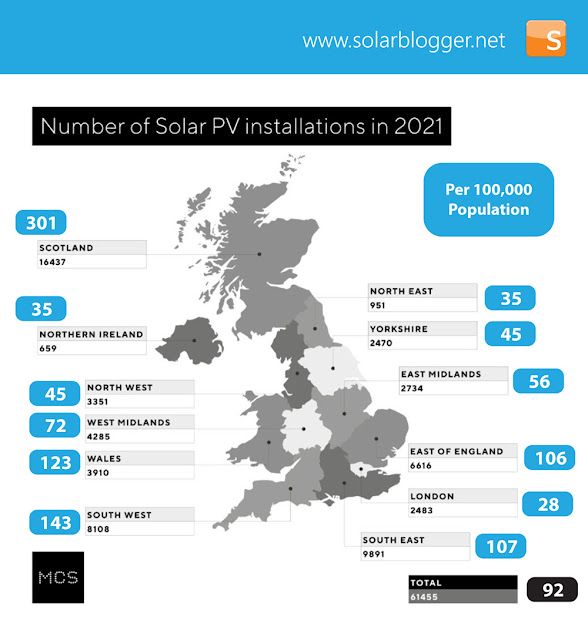
Statistics recently published by the Microgeneration Certification Scheme (MCS) show how much solar PV different regions in the UK installed in 2021.  Scotland really stood out from the pack, with more than 25% of all installations.  However, because the graphic only showed the number of installations, and didn't take into account the population of each region it doesn't really do justice to the wide differences between different parts of the UK.

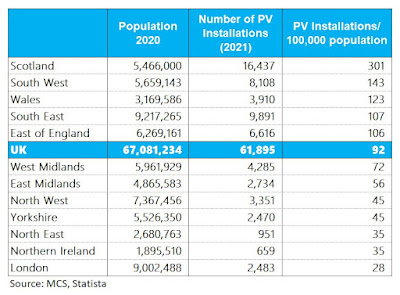
The Solarblogger has restated the figures above as the number of installations in 2021 per 100,000 of population in the region (the blue boxes).  

On this measure you can see that Scotland is installing two times more solar per head of population than the next nearest UK region (the South West) and more than three times the national average.

Compared to laggards like Northern Ireland and London, Scotland is installing more than ten times more solar PV installations per capita.  What is behind this incredible performance?


In 2015, Scotland brought in new building regulations that required housebuilders to construct homes that were significantly more energy efficient than those being built in the rest of the UK.  A year later George Osborne killed off the Zero Carbon Homes policy and developers in England have been building to performance levels largely unchanged from 2010 ever since.

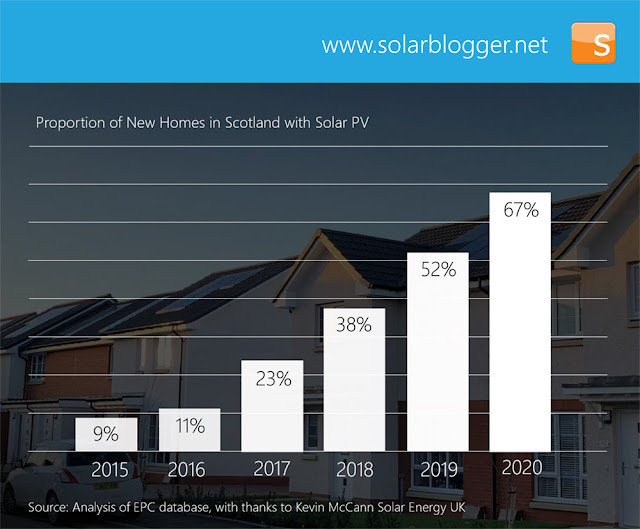
The preferred option of housebuilders in Scotland has been to meet the regulations with a combination of improved thermal insulation and airtightness, combined with a solar PV on the roof (or to be more accurate a solar PV installation in the roof).  As housing developments started under previous regulations came to an end and new projects started up that needed to meet the new regulations, the proportion of homes built with solar rose from around 10% before the regulations to nearly 70% in 2020.


According to an analysis of the EPC database in Scotland by Kevin McCann at Solar Energy UK, of the 15,447 EPCs registered for new homes in Scotland in 2020, 10,324 listed solar PV as an energy efficiency measure.

So of the 16,437 Scottish solar PV installations registered with MCS in 2021, it is likely that at least 10,324 were new homes, which would leave 6,113 that were retro-fitted to existing buildings. 

Taking this retrofit figure per head of population alone would give Scotland a score of 112 installations per 100,000 people - still impressive but it is clear that Scotland's stand out performance in solar PV installation has been driven by the building regulations for new homes.

In 2021 it is possible that there was an even higher figure for solar on new homes than that we have for 2020.   Lockdowns paralysed the construction industry for a good part of 2020, and 16,000 new homes is some way behind the long run average of around 20,000.  So the contribution to Scotland's performance from Building Regulations is likely to be higher still.

The good news is that regulations for England and Wales will soon exceed those in Scotland, with new regulations in England coming into force this June.  When that happens we should see solar PV installations per capita start to close the gap with those in Scotland.


Sunday, 17 February 2019

The Smart Export Guarantee Scheme (SEG)

Why is central government continually surprised that when the big energy companies are asked to ‘do the right thing’, they instead do what is right for them?


Central government seems to love handing responsibility for delivering energy reduction targets over to the big energy suppliers.  The scheme names come and go -  CESP, CERT and ECO – but the common factor has been to require energy companies to invest in energy efficiency measures such as loft insulation, and cavity wall insulation for homes.

Pause for a moment to think about it.  You’re asking a business to do things to reduce demand for its own product – energy.   How surprised should be we be that that foot-dragging, missed targets and ineffective measures have been the result?

In 2014, many of the energy suppliers were fined for failing to meet their targets to install insulation. British Gas was fined £11million, a development which their PR department brazened-out as a charitable donation.  One is left wondering if the energy companies see these fines a small price to pay instead of helping people spend less on energy.

With the government's new proposals for a Smart Export Guarantee (SEG) are we again about the make the same mistake by asking the big energy companies to decide what the ‘market price’ for electricity exported by householders and businesses with solar panels?

Why we Need a Smart Export Guarantee


Many people in the solar industry that I speak to have pretty mixed feelings about the Feed in Tariff.  They recognize the transformative effect of 19 years of subsidy on the industry, helping it to achieve scale and cost-competitiveness with fossil energy.  At the same time, they regret the reckless way that the scheme has been managed.  Successive ministers at DECC and then BEIS have inflicted real pain on many good people who had invested their time, energy and money in solar businesses an effort to be part of the solution.

As a consequence, the industry is genuinely looking forward to a future where it no longer needs ‘help’ like that from government and the technology can stand on its own feet as a significant contributor (maybe the dominant contributor worldwide) to the clean energy revolution.

It remains crucially important for the sector that householders and businesses that invest in solar are able to sell generated solar energy that they cannot use themselves.  This makes possible efficient and cost-effective solar systems that minimize the cost of energy rather than being sized to just meet demands in the building at times of peak output.

So, as the Feed in Tariff (FIT) draws to a close on March 31st, government is consulting on a new scheme, the Smart Export Guarantee (SEG) – that requires larger energy suppliers to purchase excess solar energy from small generators at a fair market price.

There is much to welcome in the proposals for SEG
  • the Microgeneration Certification Scheme is thrown a life-line as the only way to qualify,
  • there is to be no requirement for the building to achieve a certain energy efficiency level (EPC), a requirement in FIT that excludes many older and listed properties
  • installations that occur after the FIT closes but before the SEG is available will be able to join the SEG as soon as it opens
  • export will be metered and not estimated (as in the FIT), rewarding people that install larger systems
  • a central database of solar installations will be maintained beyond the FITs
  • the high price for bought in electricity compared to the low value of exported will encourage the deployment of battery storage and electric vehicle charging (when compared with other arrangements, for example net metering)


Concerns About the Detail


However, there are two big concerns with the proposals as they currently stand:
  1. Smart metering IT systems are not up to the job at present
  2. The reliance on conflicted businesses to set a market price

Smart Metering Systems


At recent Solar Trade Association meetings we were astonished to hear that the SMETS1 smart meters that have so far been installed ‘go dumb’ as soon as you change supplier.  Although second generation SMETS2 smart meters fix this problem, the IT infrastructure that collects the data is not yet ready to a point where this data can be shared between an energy supplier and a separate company that you have signed your SEG deal with.

It would be just like government to say ‘well, we’ve done our bit’ as they launch a completely theoretical SEG scheme, which nobody can use in practice because the billing arrangements are not ready.

That’s why we need something - dare I call it a ‘backstop’ - that makes the SEG work from day one and creates an incentive for energy companies to sort out the IT, rather than having a strong incentive to drag their feet and take as long as possible to prevent the SEG ever happening.

A backstop could look a lot like the export tariff part of the current Feed in Tariff:

  • A fixed value, for example £0.04 /kWh
  • A deemed export 50% of generation 

This would create a strong incentive for the energy companies to pull out their fingers because they are likely to be over-paying for generation where they cannot meter it.


Setting  a Market Price


Electricity costs vary during the day as supply and demand varies.  The industry would be absolutely delighted if export was paid a fair market price at the time of export – that is a price set between a willing buyer and a willing seller.

The preferred option in the SEG consultation is to simply leave it to the energy suppliers to set the price, with the only control being that the price is higher than £0.00

My concern is that the proposed mechanism will not result in a fair market price, because the companies that are being relied upon have every incentive to keep the amount of solar installed as low as possible.  They are conflicted because every time a household or business installs solar it will buy less power from the energy suppliers.  Setting a higher price for exported energy would make solar a more appealing investment and harm the business models of the energy suppliers.

The energy companies do not meet the requirement of being a ‘willing buyer’ for the power and a fair market price will not result. There is a market failure and government cannot leave pricing the invisible hand of the market – except that it can, it just needs another way.

The ‘market’ already sets a price for electricity – and one that is free from the conflicts set above.  For example market exchange Nordpool publishes day ahead pricing for wholesale electricity on an hourly basis.  These prices could be better taken as the ‘market price’ for electricity between a willing buyer and a willing seller.  Energy companies should be required to purchase from microgenerators at the wholesale market price.


Thursday, 14 September 2017

The MCS Pricing Mess and How to Fix it

New homes often have smaller solar installations.  Image: Viridian Solar


A government sponsored monopoly raises its fees by 233% .  Cue outrage from the industry, not only from the fact of the raise itself - most people accept that the Microgeneration Certification Scheme (MCS) must live within its means - but mostly from the way it was implemented.  There was no consultation, all was decided by the small, self-elected group who run the scheme.  Little thought had apparently been given to how the change would affect the diverse businesses that rely on certifying their installations to the MCS, and have nowhere else to go for this service.  The transition arrangements were wholly inappropriate.

It's not like they didn't know this was coming.  The consultation to slash the Feed in Tariff was announced in August 2015, at which point it was obvious to everyone that the MCS was facing an existential threat to its income streams, 90% of which derive from solar PV.  This could have been implemented with a lead-in time if the managers of the scheme had acted sooner.

The worst affected are  those that do a large number of low value installations, they are hit disproportionately hard by the £20 increase per certificate.  Businesses providing solar installations to house builders are right at the sharp end.  Solar installations can be as modest at one or two panels - representing only a few hundred pounds' worth of business per house - and when you're in the business of doing hundreds of these each month, those extra £20 sure add up.  To compound their situation, they are installing based on quotations accepted and ordered many months ago, and the contract may be expected to run for many months more.  One business owner estimates that this change has taken more than £100k a year from his bottom line.  Oh, and if you were about to suggest that they should just ask for more money from their housebuilding clients - forget it - that is not how it works in construction.

The other reason for the outrage is that the increase throws into stark relief the many ways that the scheme has failed the industry it purports to be there to benefit.  The purpose of the scheme was to  increase consumer confidence in the new clean heating and electricity generating technologies.  Time and again the scheme has shown itself to be incapable of tackling abuses by the small number of bad apples that have the potential to drag down the reputation of the industry.  People would be more supportive if the scheme had ever bared its teeth and kicked a few companies off the list.


So how to fix this?


If you accept that the MCS needs more income, then you have to accept that prices must rise.  But why must they be the same for every single installation?  The scheme covers 'micro generation' which means systems right up to 50kW in size.

A £35 certificate is a vanishingly small cost for a 50kWp solar installation, which might have a contract value of £50,000.  0.07% to be precise.  On the other hand £35 is a much, much larger proportion of the cost of a small 0.5kWp system on a new home.

To those that say "but the certificate costs the same for the large and the small installation" I say "so what?"

Does my seat on a plane cost the airline the same as my neighbours?  You bet!  Did I pay the same price as they did?  Almost certainly not - especially if I bought mine in a big rush last night and they are more organised and planned ahead.  Does a Gucci handbag cost 1,000 times more to make than an unbranded one.  No chance.  I could go on.

Businesses left cost-plus pricing behind years ago - you price your product at the value someone attaches to it.

A fairer way to apportion the cost of running the scheme is to charge a different amount for a certificate based on the size of the system that is being certified.  By way of example, I'm going to propose how it could work for solar PV - similar approaches could be applied to the other technologies covered by the scheme.  I don't have access to the MCS figures on installation size and number, so I'll use the Feed in Tariff (FIT) statistics to illustrate the concept.


The table shows the number of installations registered with the Feed in Tariff in the 12 months to July 2017, and the number of MWp installed, split by the FIT tariff bands.  If the MCS had been charging £35 per installation, it would have netted £1.25m of income from the 35,815 installations.

If, instead, a certificate had cost £10 per kWp installed, the scheme would have netted £1.315m - a very similar number.

I've just used a straight £10/kWp formula - as I'm working with average values.  A formula that had a minimum of say £20, for installations below 2kWp would collect more from the smaller installations, meaning that the increase for the large scale installations could be kept smaller.

Could something like this work better for industry?  What do you think?


Monday, 25 January 2016

How to Save the MCS from Irrelevance


Too Many Cooks at the Microgeneration Certification Scheme


In 1964 a 28 year old woman called Kitty Genovese was brutally attacked in front of her apartment building as she returned from work.  According to accounts in newspapers, the attack lasted at least half an hour and, despite her repeated cries for help, 38 people who either heard or saw the attack did not intervene or even call the police until after the attacker had fled and Genovese was dead.

Why?

Although it later emerged that the number of witnesses was exaggerated in the newspaper reports, psychologists have now proven that the more people who are around, the less likely it is that someone will act to stop something bad happening.  They call it the ‘Bystander Effect'.

For example in a classic experiment by Latane and Darley, subjects were placed in a waiting room either on their own or with others present.  As they sat there, the researchers had organised for the room to start filling with smoke.

When the subjects were on their own in the room, 75% reported the smoke to the organiser.  When there was three subjects in the room, the smoke was reported only 38% of the time.

One of the explanations for the Bystander Effect is termed “Dilution of Responsibility”.  The more people there are around, the more likely you are to leave it to someone else to do the right thing.  Obviously if everyone thinks the same, then no one does anything.

Which brings me on to the Microgeneration Certification Scheme

As the recent Feed in Tariff review unfolded, I heard many people wonder what the purpose of MCS would be in a post-subsidy world.  “If there’s not a Feed in Tariff, why would anyone ever bother with MCS?” was a typical sentiment.

This completely sums up the failings of the scheme.  If it’s just seen a tick-box exercise, a gateway to government handouts then absent the subsidies and the scheme is worthless.  As a consumer protection scheme it’s hard to find anyone in the industry that believes it works.

The irony of this is that the MCS was created by the industry itself.  If you think the management of the scheme is bureaucratic to the point of paralysis, or that its police have no incentive to drive out poor practice (or even look for it) in the companies they audit.  If you think the installer audit focuses more on the accuracy of paperwork rather than the quality of the outcome for the consumers; or the way you have to demonstrate you meet the “competence” requirements are baffling and incomprehensible; then apparently you only have yourself to blame.

After all, the people running it are the representatives of trade associations, certifying bodies, training providers and government bodies that make up the steering group, and you can see who they are by looking here.  There are no less than thirty two bodies represented.   Thirty two bums on seats at meetings.  Thirty two people to have a say on any decision.  Can you imagine how those meetings must go?


And thirty two is plenty enough people to produce the dilution of responsibility for no one to act to put things right.  Our industry representatives have allowed the MCS to become what it is due to the Bystander Effect, and it’s time for industry to demand that our representatives start representing us at the MCS.

This time last year, the Solar Trade Association produced a manifesto for change at the MCS.  It called for improvements to its governance, rigorous enforcement (and expulsion of substandard companies), measurement and reporting of the quality of installations (and therefore the success of the scheme), and spending some of the vast accumulated reserves promoting the industry and accredited installers to the public.

The solarblogger has heard that against the reluctance of the‘Interim CEO and Chairman’ a small group of members of the Steering Group were able to push for changes based on the ideas in this manifesto.  A 100-day plan to enact the changes was agreed, but a year later and little has changed, the actions bogged down in a sticky morass of procedure and delay.  Instead of hearing that these urgently needed changes have been made, we’ve had the scheme sending out communications about moving to a new legal structure to become a charity.  It’s spent the year rearranging the deckchairs.

The MCS has been given a stay of execution.  The outcome of the Feed in Tariff review has given it a short window where people will still want to use it to access government support.  The industry wants a scheme that is responsive to its needs, cost-effective and delivers effective consumer protection, something MCS is not providing at present.  The team appointed to run the scheme in its new charitable status need to get on with making the changes necessary for MCS to become useful in a world without subsidies and our industry representatives should stand up and help make it happen.

Thursday, 28 May 2015

Solar Attrition Rates

An Analysis of the MCS Installer List


I recently had the opportunity to have a look in more detail at the list of installers registered with MCS, and what I found came as quite a surprise to me.

The number of solar PV installers registered with the Microgeneration Certification Scheme (MCS) has been on a declining path since the boom of 2010-11.  This is not news to anyone in the industry.

Right now, the number of solar PV installers registered with MCS (removing duplicates) is around 2,640, a fall of 24% since 2013.  But when you look at the actual companies that make up this headline figure you find that less than 50% of the solar PV installation companies on the list in 2013 remain two years later. 1,822 companies have left the market, but 980 new companies have joined the list in the last two years.


Churn Rates in Solar Installation Businesses

Turning to the list of solar thermal companies, we see that the decline in numbers has not been as severe as for the PV installer companies, a 13% drop from 1,298 companies in 2013 to 1,130 now.  However, the churn rate is just as eye-watering.  Nearly half of the solar thermal installers registered with MCS in 2013 are no longer on the list, but the 635 that have left have been replaced by 467 new companies.

What's going on?  Are these attrition rates normal for similar industries (home improvements, heating, electrical works)?  Or is there something 'special' about our solar industry?

Thursday, 18 September 2014

What Has the MCS Ever Done for Us?


How to fix the Microgeneration Certification Scheme (MCS)


You pay your registration fees each year. You research each and every change to the regulations and make sure to adjust your paperwork, your working practices and the products you offer to keep in line with the rules. You engage with the annual audit of your work and put right anything the auditor finds. You go further and make changes to your processes to ensure these issues never recur. 

You are, in short, an ideal MCS installation company. The kind that the folks sitting in London running the scheme like to think that they have produced. 

The problem is that there's another installation company across town. They also have an MCS accreditation, after all it's needed for customers to access government incentive schemes. Their workmanship is shoddy, they don’t seem to be in it for the long haul and cut corners to make a quicker buck. They have accumulated a string of non-conformances on their paperwork from the annual MCS inspections but nothing ever happens, so they don't waste their time making changes. The inspector comes once a year, takes a cursory look at an installation of the company's own choosing (inspecting the roof work from the ground). So long as the company has one half-decent installation to show the inspector, they're good for another year.  This company can undercut its more diligent neighbour because it doesn't have the expense of bothering with the requirements of the MCS scheme or spending the time and care to put in the "high quality installations" the scheme claims to ensure. 

Back among the glass towers of London where industry representatives meet to oversee the MCS this company simply doesn't exist, or is at worst a 'bad apple', an isolated case. 

Unfortunately, the second company and their like are a very real in the minds of people who work for companies like the first and have to compete with them every single day of the year.  I have heard numerous stories from colleagues in the industry about companies "getting away with it", about complaints to MCS not adequately investigated and annual audits of installations that amount to little more than checking there really is a solar installation on the roof.  

This, in short, is the crisis of confidence that the MCS must recognise and urgently work to fix.  If scheme officials knows that there isn't a problem, that it really is just a very few bad apples then they should publish the evidence that has led them to reach this conclusion thereby reassuring an increasingly sceptical industry. 

Many people believe that way the scheme is managed has had the perverse effect of creating ’Natural Selection’ for the least desirable traits in registered companies.  Without meaningful audits of installations and a credible threat of expulsion from the scheme, the scheme penalises the diligent by imposing higher costs, handing a competitive advantage to those that join the scheme but don't bother trying to meet the standards. 

It is a great frustration for those of us who have worked  in the MCS technology Working Groups to hear such views.  If the enforcement really is this poor, why bother writing rules?  If the only companies that are applying the standards are those that would have worked to a good standard anyway then what’s the point of all those hours donated free of charge to the scheme.


Unless MCS changes


As I revealed in an earlier blog, the MCS is sitting on a cash pile of £6.6m, growing at the rate of £1.3m last year. That kind of money would pay for a lot of surprise audits. Perhaps industry would even be willing to pay slightly higher fees and put up with more intrusive audits if proper enforcement levelled the playing field and drove the bad apples out of the industry.

My colleague at the Solar Trade Association (STA), Chris Roberts has written a draft White Paper: 'Is the MCS Fulfilling its Potential?' to stimulate debate and comment from STA members on the MCS. Having collectively contributed more than 90% of the scheme income the views of the solar industry deserves to be heard, and I urge everyone in the industry to join the debate by reading the paper and feeding in your ideas and evidence to Chris. 


Monday, 15 September 2014

The MCS Hoard

So here's an interesting thing about the Microgeneration Certification Scheme  (MCS)

The MCS is supposed to be self-funding, with fees applied on a 'per-registration' basis with these fees currently set at £15 per registration.  MCS installation companies also pay £110 annual fee, collected through the Certifying Body that accredits the installer.

Gemserv administers the scheme, and its latest annual report show that MCS has a surplus of £6.6m at the end of March 2014.


Indeed, the surplus grew in the most recent financial year by £1.3m, so this is not purely an artefact of the dash for PV of late 2011.

Figures for the number of installations the registered on the scheme database are available from the MCS website and show this:


So there were 122 thousand installations in the same period that the scheme ran a £1.3m surplus, corresponding to £10.65 of surplus per installation.
 
 
All this begs the question, why?  Why is the scheme building up such a large surplus, when its terms of reference are to be no more than self-financing?  What's all this money for?  How does MCS anticipate spending it within its terms of reference?
 
I'm personally not against accumulating some money from each installation if it's spent for the good of the whole industry, but just saving it up for a rainy day?  What use is that to anyone?
 
How would you spend it if you were in charge of the MCS?  Would you just lower the registration fee, or would you be happy to keep paying the extra, were the money to be spent on something useful.  Write in the comments below...


Saturday, 23 August 2014

Is RHI More Trouble than it’s Worth?


To get support from the domestic Renewable Heat Incentive (RHI), there are some hoops it’s necessary to go through, but how much do these add to the cost of a solar thermal installation?


If you install a solar thermal system in the UK you can receive financial help from the government’s Domestic Renewable Heat Incentive (RHI).  RHI payments vary depending on factors such as the size of the solar panels, their location and orientation and especially the hot water demand of the house (which is taken from the number of people who live there).  It can be worth between £1,500 and £3,500, paid out over the first seven years.  In addition to the payments householders also benefit from savings on energy bills, the value of which are much higher the RHI payments over the long life of the solar heating system.

In order to qualify for the RHI, the solar panels must be of a certain quality - achieving accreditation with the Microgeneration Certification Scheme (MCS) or SolarKeymark, the installation company must also be MCS accredited and the household needs to demonstrate that it has taken straightforward energy efficiency measures such as insulating the loft and filling cavity walls (where there are cavity walls to fill).  The way that this last requirement is proven is to produce a Green Deal Advice Report that doesn’t show loft insulation or cavity wall insulation as a recommended measure.

In recent weeks it has come to light that some solar installation companies are advising customers that there’s so much cost and bureaucracy associated with installing a solar thermal system that qualifies for the domestic RHI that they are better off avoiding the scheme.

Let’s have a look at whether this argument stacks up.

Extra Costs for the Installation


Let’s assume that the installation is of identical quality both with and without the RHI.  The installer cuts no corners on the installation standard and that the equipment that is used is registered with the MCS or Solarkeymark.

The installer must log the installation onto the online MCS database for the customer to be able to claim the RHI. There is a charge from MCS of £15 to do this.  Let’s add £20 to that to pay for the time for someone to fill out the online forms.  Total £35

In addition, the household needs to pay a Green Deal Assessor to visit and produce the Green Deal report.  You don’t need to undertake any of the recommended measures unless they include loft insulation or cavity wall insulation.  The report costs between £150 and £250. 

So the total Variable Costs (cost per installation) are between £185 and £285

Annual Costs for the Installer


For an installer to be MCS accredited, there are annual fees to pay and administrative time required.  Let’s take a look at the costs for a smaller company, as it is generally thought that the burden is highest for these.

The solar installer must pay a fee to join the scheme and be audited each year.  For a solar installer with less than 10 employees the MCS annual registration and audit fee comes in at around £470 (see NAPIT fee sheet). 

In addition there is an MCS requirement that the solar installation company must be a member of an approved renewable energy consumer protection code.  Joining RECC depends on the number of staff, but for 1-6 employees it’s £250/year. 

Let’s assume the company wouldn’t operate a formal quality system if it wasn’t going to be MCS accredited and add £1,000 of admin time to these figures to pay an office administrator to maintain the paperwork that the scheme requires each year and make sure the document handover packs and quotes remain compliant with the scheme.

Both the fees and overhead costs fall (per technology) if the company installs other MCS renewable energy technologies as well as solar thermal, but let’s assume it doesn’t.

For this small company then, the total annual Fixed Costs of maintaining an MCS solar installer registration is £1,720.   


Total Cost


The total additional cost per installation of being RHI compliant is found by dividing the Fixed Cost by the number of installations the company does each year and adding this to the Variable Cost per installation.

This is where the costs of accreditation can start to look very high – it depends enormously on how many installations the installer does each year.  See the table below.


How the admin costs of an RHI compliant solar system varies with the number of installations
the installation company does each year


If the installer does only one or two solar installations a year then, yes the costs of RHI compliance is high compared to the benefit in claiming the RHI, but even at only one system a month the extra costs start to become really quite small compared to the RHI payments. 

The more installations that the company can do each year, the more the costs trends down towards the cost of the Green Deal Report.   Nor will every customer see this as a valueless piece of paper; some may value the guidance on further measures they could take to improve their energy efficiency.

The problem for the RHI is that until the scheme starts to drive demand for a reasonable number of installations, then for small companies that perhaps combine general plumbing with a very occasional solar installation the barrier costs of being MCS registered don’t look worthwhile. 

An excellent time to encourage a customer to consider solar heating is at the same time that a hot water cylinder is being replaced, but the plumbing company standing in front of the customer won’t offer this option if it isn’t MCS registered  If they do offer solar they might encourage the customer to ignore the RHI.  This is, of course, a classic chicken/egg situation.  Unless this plumbing company starts to offer more customers solar under the RHI, they’ll never see enough demand to justify MCS accreditation.

It would be good if there was a way to encourage this plumber to promote solar thermal to customers, perhaps in cooperation with a local accredited solar installer.  For any installation company that’s doing more than a handful of solar thermal installations each year, the cost of the RHI requirements are small relative to the RHI payments.


However this is not to say that MCS couldn’t do something to reduce the burden on smaller installers to meet the ever-increasing demands of the scheme.

Sunday, 10 November 2013

Heat and Power

Early signs of a rebalancing of the renewables market


The Microgeneration Certification Scheme (MCS) November newsletter was recently released, and a graph caught the eye of the solarblogger.  It is reproduced below.


The total number of MCS registered installers has been falling for some time.  Companies registered to install photovoltaic (PV) solar technologies dominate the numbers, and since the painful tariff adjustments of 2011, the number of registered companies has been steadily falling.  In the last 12 months the number of solar PV installers has fallen from around 4,300 to around 3,000.

Two features of the scheme may mean that even these figures are an over-statement of the number of active PV installation businesses.

First, since businesses renew annually with the scheme, a company decision to exit a market can take some time to feed through into the figures.  Falling registration figures will trail by an average of six months.

Second, renewal is significantly less expensive than a new registration with the scheme.  This asymmetry causes business to retain their MCS registration even when they are not actively working in the market “just in case things pick up.” 

Industry colleagues estimate that around 10-25% of MCS registered PV installers are not actively selling solar PV.

But none of this is news.

The thing that really jumped off the page for the solarblogger was that while the registered PV installer numbers have continued to fall, the total has actually risen since August 2013. 

There has been an increase in the number of businesses registering to install heating technologies such as biomass, heat pumps and solar thermal. 

Details of the domestic Renewable Heat Incentive (RHI) were announced in July 2013.  This scheme pays households that install heat-generating renewable technology and will go some way towards rebalancing the UK government’s lopsided support for renewables.  A successful domestic RHI alongside a stable Feed in Tariff could deliver long term growth for both renewable heat and electricity.


It seems like industry might just be starting to believe in the RHI.


Wednesday, 12 June 2013

SAP 2012 Gives Solar Heating a Boost


What the Government's new Calculation Means for Solar

Credit: Viridian Solar


Ahead of the announcement of the new Building Regulations later this summer, BRE has published the accompanying energy calculation, the Standard Assessment Procedure, or SAP.  

If you think this document is only relevant to the new build sector, you would be wrong. SAP is also the basis for Energy Performance Certificates (EPCs), and therefore is also highly influential in the refurbishment of existing homes, for example under the Green Deal. SAP Appendix H is also used by the Microgeneration Certification Scheme (MCS) for installers of solar heating to provide customers with an estimate of their likely energy savings. Finally, whichever of the proposed routes to calculate payments under the forthcoming incentive scheme for renewable heat, the domestic RHI, is chosen, SAP lies behind it somewhere.

This document is not for the faint-hearted, comprising a thick booklet of dense calculations and notes. Fortunately the solarblogger has done the heavy lifting, so you don't have to...

A detailed assessment has been published as a briefing document available from the Viridian Solar website, but here's a quick round up of the headlines:

►  New postcode-based irradiation data (PV&T)
The UK average irradiation remains the same, but the value varies depending on location with northern Scotland around 10% below the average and southern England around 10% above.  This feeds directly into the solar pv estimate, but results in a smaller +/- 5% change across the country for solar heating.

► Updated fuel carbon emissions factors (PV&T)
Carbon savings from solar electricity reduce by 2%, carbon emissions avoided by solar thermal replacing natural gas increase by 9%

► Addition of hot water use factor (T)
There is a 29% increase in hot water used from the hot water cylinder in the solar thermal calculation if no electric showers are present, and a reduction of 36% if only electric showers are present. This produces a 20% increase in solar heating energy in SAP Appendix H compared to the previous version

► Reduction in solar pump electricity consumption (T)
The 75kWh flat rate for the solar pump electricity consumption is reduced to 50kWh for mains powered solar pumps, based on evidence from EST solar thermal field trials submitted by EST and Solar Trade Association

► Addition of second order coefficient for thermal panel efficiency (T)
Creates a level playing field (for more information see my paper on this issue here)

So What Does it all Mean?


Photovoltaics


For solar PV, the main impact will be on new build housing.  Here the changes are relatively neutral, being a 2% drop in carbon savings on average due to the lower emissions factor for solar electricity. Of course, compared to the previous version of SAP, which used a single figure for irradiation for the entire country, some areas have increased significantly while others have fallen. (See map, below)

Credit: Viridian Solar

For retrofit PV the recent MCS PV installation Guide has already implemented a new energy calculation based on a different set of  irradiation data.  This produces slightly higher energy outputs than SAP 2012.  The discrepancy could be explained by the different uses of each calculation, with the MCS method taken to predict year one energy (with solar panel performance degradation taken into account later for any financial forecasts).  By contrast, SAP is more aimed at producing a whole life average estimate.

Solar Thermal


For solar heating, the calculation impacts both new build and retrofit, and in a really positive way. (See map, top of post)

In new build, carbon savings will increase significantly for almost all homes with solar heating.  The new adjustment factor for electric showers rightly produces a disincentive to install these alongside solar heating.  I reckon that overall the boost to solar heating carbon savings from all the changes is worth between 17% and 31% depending on where the house is.

In retrofit situations, the MCS installer will perform an energy calculation  for the customer using SAP Appendix H. The new version of SAP will an average of a 20% boost to the solar energy estimate, again differing depending on the location of the installation.  

Further changes are coming down to road to improve things even more in MCS, more on this soon....