Showing posts with label safety. Show all posts

Friday, 18 March 2022

How Safe is Solar PV?

 Putting the Numbers in Perspective
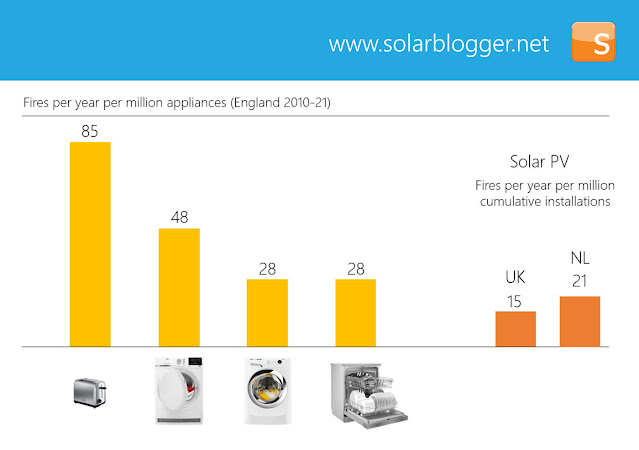

Comparing the fire risk from solar PV with that from common electrical appliances
Comparing the fire risk from solar PV with that from common household appliances


Recent research has advanced our understanding of the risk of solar PV fires.  The Building Research Establishment (BRE) and the Netherlands Organisation for Applied Scientific Research (TNO) published reports of their investigations of fire incidents involving solar PV installations in the UK and Netherlands respectively.

In this blog we take a look at the numbers and try to put them in perspective by comparing the findings from the reports with statistics for fires started by household appliances.


Fire and Solar PV Systems – Investigations and Evidence, Coonick et al, BRE National Solar Centre, 11th May 2018 (link)

Researchers from the BRE National Solar Centre investigated 80 fires in the UK that involved solar PV systems in some way, either because it was a potential source of the fire or because it was involved in a fire that started elsewhere. 

The solar PV system was found to be the source of the fire in 56 of the incidents.   Of these 22 were classified as serious fires (those that were difficult to extinguish and spread beyond the point of origination), with the remainder being classified as either localized or ‘thermal events’ (smoking, overheating).  The investigation looked at incidents that were both historical (33 that happened before the project start date of July 2015) and live (47 that occurred between July 2015 and February 2018).

It would be misleading to compare the number of fires caused by solar with the number of fires caused by other electrical appliances - because there are so many more of these.  To make the comparison fair we should take into account the number in operation.  I'll be using the number of fires each year per million systems in operation as the benchmark figure.

Taking the overall proportion of fires where the PV system was found to be the source of the fire (56 out of 80) and applying this figure to the 47 live incidents collected over the 30-month project length gives a rate of 13.2 solar PV fires/year.  

In January 2017 – half way through the study, the cumulative number of PV installations in the UK was 904,033 systems.

So our rate of 13.2 fires in 0.904m systems translates into 14.6 fires per million operational solar PV installations per year.


Brandincidenten met fotovoltaïsche (PV) systemen in Nederland. Een inventarisatie.  Bende EE & Dekker NJJ, TNO, 13th March 2019 (link)

The TNO researchers identified 28 incidents in the period 2015-2018 categorised into both residential properties and business (which includes both commercial buildings and ground arrays).  21 of the fire incidents occurred in 2018, and 15 of these were on residential properties.

The Central Bureau of Statistics (CBS) publishes data on the number of solar installations in the Netherlands.  At the end of 2018 there were 720,522 domestic installations, and 67,313 commercial installations.

The calculated fire rate for solar PV systems on domestic properties based on 2018 is therefore 15 in 720,522  or 20.8 fires per year per million systems in operation.


Comparison with Common Electrical Appliances

Data published by the UK Home Office on incidents attended by the Fire and Rescue Service in England breaks out the causes of fires, and from this we can get numbers that allow us to compare with the figures for solar PV.
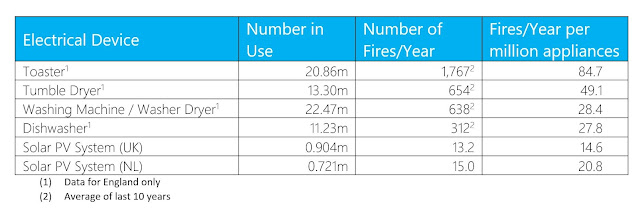
Workings are detailed below, but what can be seen from the figures is that solar PV systems safety compares very favourably with that for electrical appliances that we wouldn't think twice about having in our homes.

It may be highly reassuring to say that a PV solar system is safer than a toaster or tumble dryer, but that doesn't mean that the solar industry should complacently sit back and do nothing.  Both reports highlighted common faults that can lead to fires.  In my next blog I'll be looking into these to ask what steps the industry can and should take to improve the safety of solar systems further.


Sources and workings on figures for electrical appliances 

In 2020 there were 27,292,000 UK households.  England represents 84% of UK population.  So let's assume 22,925,000 households in England.

98% of UK households own a washing machine, giving a number in use in England of 22.47m

91% own a toaster, giving 20.86m in use in England

58% own a tumble dryer, 13.30m in use

49% own a dishwasher, 11.23m in use


The Domestic appliance fires dataset was accessed from this UK government web page.  The average number of fires each year in England from 2010 to 2020 was used.  This figure is divided by the number of appliances in use (in millions) to get a rate per year per million appliances in use for comparison with the solar PV figures.

Wednesday, 20 April 2016

MCS012 Finally Comes into Force

Image: Viridian Solar Roof Integrated Clearline Fusion System


That the implementation of MCS012 has been a challenging process must be obvious to any outside observer.  The standard for assessing the performance of solar roof mounting kits for wind resistance, weather tightness and spread of flame performance was first published in 2012.   Indeed, it was written into the 2013 Guide to the Installation of PV Systems as a mandatory requirement, and 130 different certificates have now been issued to roof mounting kits and components.

However, a first delay was made necessary when so many manufacturers had left things until the last minute that a log-jam was created at the test laboratories.  MCS wrote out to installers to announce that the requirement would be suspended until further notice.

A subsequent hold up due to concerns raised about EU notification was followed by inconsistencies between certifying bodies in the treatment of ‘universal’ roof integration kits that needed to be ironed out.

After such a delay, it feels like old news that the use of mounting kits accredited to MCS012 will eventually become mandatory for MCS registered solar PV installations on pitched roofs from May 2nd 2016, but it brings some big changes for the industry.

Read more about what MCS012 means for installers here.

Above-Roof Systems


MCS012 mounting systems intended to mount the panels above a roof covering are tested only for wind resistance (where they can be shown not to affect the fire resistance and weather tightness of the roof covering beneath).

This test is important because the resistance of most roof hooks to pull-out forces is determined not by the strength of the roof hook itself, but by the strength of its fixing to the roof.  In sound timber, this strength is determined by a combination of the size and number of the wood screws and the gauge of the timber into which they have been screwed.

Because of this, resistance values from tests where the hook is fixed to larger timbers than those used in the UK cannot be used as they would over-state the strength.

Some manufacturers have not tested at all, but instead used EN1995-1-1 (or similar) to calculate a resistance force for their fixings.  Such calculated screw pull out forces only apply when the timber to which the screw is attached is wider than 12x the diameter of the screw.  Unfortunately with slender UK roof trusses, this is usually not the case, making calculated resistances invalid.

A roof hook tested to MCS012 will have a certified, tested resistance in kN to uplift forces, creating a level playing field.  Solar installers can use this resistance with confidence to calculate the number of  hooks required for their installation that would have a combined resistance higher than the design wind pressure multiplied by the installed panel area.

In-Roof Systems


Solar systems that replace the roof covering have more significant testing requirements under MCS012, including a deluge test for weather tightness, a pressure test for wind uplift resistance and a test of the spread of flame.

The spread of flame test is a requirement for all building materials used as a roof covering.  Building regulations, e.g. Approved Document B in England, impose  limitations (area and location limitations) on the use of materials that do not achieve a high enough performance rating.  To comply with building regulations without a fire rating is impossible (which raises questions about how some roof integration systems were compliant before MCS012 forced those manufacturers that had not already done so to perform these tests).

Read more about building regulations for fire and roof integrated solar here.

It was this test of the spread of flame that has caused the most recent delay to MCS012 coming into force.  The original version of the standard had not properly accounted for universal roof integrated mounting systems (those that can be used with pretty much any solar panel).

MCS012 was previously silent on how to interpret the fire performance test for universal roof integrated mounting systems when these relied on the presence of the solar panel to achieve the fire rating of the system as a whole.  As a consequence, certifying bodies (CBs) were left to develop their own interpretation, which they duly did, but inconsistently.  Some CBs issued an MCS012 certificate that limited the system to be used with only the module with which the system had been fire tested, others tested with only one panel but issued the MCS012 certificate to apply when the mounting kit was used with any module at all.

The first interpretation is incredibly limiting for systems that give the installer freedom to choose any solar panel, implying that manufacturers of such systems would need to repeat costly fire testing with every single type of panel that their customers might want to use.  In theory, the second interpretation is dangerous to public safety as it extends the tested fire performance to an installation using solar panels made from plastic, wood or, for that matter, chocolate.

Solar panels had rarely been fire tested before MCS012 made it mandatory.  Their design appears so undifferentiated that it seemed obvious that they would perform identically in such tests.  However as tests proceeded, reports emerged that outwardly identical-looking products were performing very differently in the fire test.

At the same time, regulators in the US had found a similar issue with fire rating of solar panels and published standards (UL 1703) categorising panels into 15 families that could be considered to have the same fire performance for the US fire tests. An international precedent exists.

The MCS012 working group decided that the responsible reaction to this new information was to choose the most restrictive (and therefore most safe) option - that a certificate can only be issued for the roof integration system with the panel(s) with which it has actually been tested.  This change was implemented in the latest version of the standard.

Roof integration systems that use a dedicated solar panel or solar tile are unaffected by this change, as they will have already been tested with the only panel type they use.

However, manufacturers of universal solar roof integration kits that work with many types of solar panels now have a number of options available to them for their products to remain in compliance with the requirements of the MCS scheme (and building regulations).  They can either:

(1) Re-test the system without the solar panel in place to achieve a certified fire rating that is independent of the fire performance of the panel;
(2) Re-test with a range of panels to achieve a certified fire rating.  Installers must then choose panels to pair with the mounting system from a more limited range; or
(3) Change installation instructions such that the system must be installed above a material that achieves an adequate fire rating in its own right (for example a fire board or fire-proof membrane).

Now this is sorted out, and the certification consistently applied, the standard has been made mandatory for PV installations.  Work to understand which features of a solar panel's design affects its fire performance is planned, with the goal of creating a similar set of product families to those in use in the US, but based on UK fire testing standards.  In future, this would allow a manufacturer of universal systems to be used with a much wider range of panels based on a much smaller number of tests.


Friday, 21 June 2013

Wrong on Many Levels

The solarblogger is Concerned For You


While out and about near Cambridge, I passed a building site and snapped this photo. 

 
Discretion is my middle name


I guess I was planning to rant on my blog about one or all of the following (take your pick):

  • The box-ticking mentality that results in house builders giving their customers a 0.5kWp solar photovoltaic system – something that no one would ever buy for their own home (see my earlier blog Specifying Solar for New Build Houses)


  • Why the designers didn’t choose one of the many low-profile roof integrated solar options that would have been so very easy to do as a new roof was going on anyway.


It was only when I downloaded the photo and reviewed it on a larger screen, that I realised what I’d inadvertently caught.

Did you see that in the background?  If the guy working on the roof between the solar panels slips, they’re both coming down.

Can you see what it is yet?


I’m guessing what we’re looking at here is the result of having to install to a price. In new build, the panels are often fixed in place by the roofing contractor and you can’t complete the electrical installation until there’s mains power in the house (which normally means long after the scaffolding has gone). Repeat visits to site are costly, better to do it all in one trip than to make the electrical connections to the panels when the scaffold is up.  Must be really tempting to just nip up there on a ladder and get it done.

Is there a better way?  Well, one option is to roof-integrate the solar panels at the same time the roof covering is going on, pass the electrical connections from each panel through into the roof space and the whole system can be connected up from inside the building.

Perhaps you think I'm worrying unnecessarily for the welfare of my solar colleagues?  Is this 'elf and safety gone mad?  If the ladder was tied on, would that make it OK? Please post your thoughts in the comments box below...


Note Added: 22/07/2013

People have started to send me photos of their own - I have started an image set on Flickr here.  Please keep 'em coming!